DIGGING DEEPER
“The subterranean miner that works in us all,
how can one tell whither leads his shaft by the
ever shifting, muffled sound of his pick?”
– Herman Melville, Moby Dick
When you’re in a hole, keep digging. You won’t get out, but you might find treasures. Moving through each strata you’ll go back in time, and eventually you might come out the other side of the planet.
The story of this project begins in San Francisco on October 8th, 2022, two days before Thelonious Monk’s 105th birthday. For the occasion, I was invited to play a solo set of Monk’s compositions at SFJAZZ in their club-sized venue on the ground floor. Normally I play in bands, preferably in the mix somewhere instead of out front, but I had been playing a good number of solo shows since 2018. That is when I released WORK, my recording of Monk’s complete works, which generated some ink and interest in solo bookings.
The SF show was focused and flowing. It was one of those nights when I was relaxed and felt like I had the ability to play pretty much whatever came to mind. I played two sets, covering 20 tunes. I had a few friends in the audience, including producer and writer David Breskin and his wife Isabel. I was a known quantity to Breskin, as we had just begun producing some projects together including Thisness, released earlier that year. As a poet, Breskin had written an early book called Escape Velocity with the tripartite structure of “Evidence,” “Well, You Needn’t,” and “Rhythm-a-Ning.” He had been thinking about Monk’s music for a long time, and had even pledged a lifelong alliance to the composer by naming his son Thelonious. So our feelings about the importance of Monk’s music were mutual and fertile ground for some future project.
The next day I was on the phone with Breskin shooting the breeze. He said that after the show Isabel had made a comment that gave him an idea. The comment had to do with the experience of seeing someone interpret a large amount Monk’s music without just reciting it or being subsumed by the task of trying execute it correctly. The live concert is a fundamentally different experience from a studio recording, as you witness someone wrestling with the pull of Monk’s personality in real time. So Breskin’s idea went something like this: it’s one thing to record all of Monk’s music in the studio, but wouldn’t it be something to make a concert film where you play the entire songbook in one night?
My immediate thought was that it probably wouldn’t be possible, physically or logistically. It would be expensive, a lot of pressure, and possibly humiliating if my stamina and concentration didn’t hold up. But from experience I know when I have these thoughts, the next thought will be: well, why not? Are you afraid that you can’t do it? Or that you won’t be able to make it interesting? Doesn’t Monk’s music deserve the greatest tribute you can think of? So I said, give me a year to practice and let’s see if we both still think it’s a worthwhile thing to pursue.
I started in on a new excavation of Monk’s works, tailoring my approach to what would work best on stage. In 2017, I had recorded the six-disc album in my spare time over the course of a year. This time around, I would need to find a sequence that I could get through in a single evening. I wrote setlists to imagine the arc of a four hour concert. Once I could get my mind around the scope of the project, I decided it was possible and worth a try.
If you want to make a film, you need a filmmaker. And you need one who can somehow capture the event and then make many hours of solo guitar footage visually compelling. So the first call was put in to Frank Heath, who has those kinds of shooting and editing chops. He was the guy that Breskin had in mind from the beginning, and he was willing to do it. We now had a plan and just had to find the time.
My one-year deadline stretched into two as things kept coming up. There was a lot going on at the time – three kids, moving, touring, teaching, writing, recording. Frank had a stack of plates spinning as well. I spent much of the early part of the year writing, recording, and releasing my next album, Miniature America. But at some point you have to mark the calendar, so we settled for October of 2024. Frank began to assemble his team, and I set out to find the venue. There was really only one location that made sense, which is the Jazz Gallery on 27th Street in Manhattan. The Gallery for me and many others is a kind of creative home base, where I’ve debuted every new project since my first album 20 years ago. It’s a place where I could be relaxed enough to get the job done right. I called up the artistic director Rio Sakairi and she was, as usual, down to collaborate on some kind of unusual project, so we booked it.
After filmmaker and venue, the last piece of the puzzle was sound recording, and everybody in our scene knows that the guy to get for live events in NYC is Joseph Branciforte. Luckily the calendar aligned and I got him on board. So now all that remained was to get in shape before October. Deadlines can work magic if you take them seriously. And as more people get involved, the more serious it gets.
It was now about eight months before the gig, and I figured I should start with a new comprehensive survey of the music, where I take notes on everything that should be memorized. I originally recorded the 70 songs that are generally credited to Monk, but I made a few editorial decisions for the live concert. “Blue Sphere,” “Something in Blue” and “North of the Sunset” are improvised blues recordings without a repeated head (melody at the beginning and end), so those fell off the list. I also removed “Children’s Song,” which is a cover of the nursery rhyme “This Old Man.” To include these songs in a concert felt unnecessary and pedantic. This gave me a working list of 66 tunes. It seemed that with versions slightly shorter than those on the recording, I could get it done in four long sets.
During this same period of time I was also gearing up for the NYC Marathon, which would happen just two weeks after the Monkathon. I figured I could do a kind of parallel training for both projects, where the discipline of one thing might inform the other. I had run the race three times before with no structured preparation and varying degrees of failure. I wanted to just make it through at a consistent pace, which would require making a plan and sticking to it. I figured it would teach me something about musical practice as well, since repetition is at the heart of both pursuits.
I’m interested in what kinds of tasks can be done with steady, incremental work. Inspiration can be unreliable, so I try to make habits instead, dutifully sharpening tools to keep them ready for the creative mind to reach for at the necessary moment. In a true flow state, you get the idea and the ability to articulate it at the same time. This is the goal, but in the meantime a pretty solid thought expressed with clarity is better than an amazing one that you can’t find the words for.
I kept a video diary of my approach to each of the 66 songs, and a notebook of my musical and marathon training. Throughout the spring and summer I trained with an unusual amount of focus. Daily obligations still took up most of the time, but I was figuring out how to use time more efficiently. It’s commonly told to students to work slowly in order to play fast, crawl before walking. Less common is the advice that sometimes you need to jump to the final tempo to see what it feels like. In the deeper layers of training strata, the rules start to bend: practice tunes fast in order to play them slowly, sprint uphill to be able to cruise at a medium pace.
By the time fall rolled around, things were shaping up. Monk’s birthday week arrived, which conveniently coincided with a break from my teaching schedule at Princeton. We planned for two nights of shooting, which meant taking over the Jazz Gallery for most of the week. Setup on Tuesday, gig on Wednesday, dark Thursday, second gig on Friday. I wanted to perform the whole program twice in order to have choices between the two nights. The Gallery was transformed from a performance space into a movie set, with camera operators hidden behind baffles and lighting rigs surrounding the stage. I brought in my 1940 Gibson ES-150 guitar and EH-150 amp, all of my Monk records, my notebook, my clothes, some snacks, and that was about it.
The shows sold out quickly, and my memory of the concerts is mostly a blurry vision of notes pouring out of the guitar. When I watch the footage I can see that I’m making certain decisions, but on stage I felt like more of a conduit for the music than an active participant. As they say of well-made compositions, the songs play themselves. After the show, instead of exhaustion I felt like I had plenty left in the tank.The music and audience had given me at least as much energy as I had used. I had scoured the limits of my abilities to pay tribute to the miraculous body of work of Thelonious Monk. And that was all that I wanted to do, really.
A couple of weeks later was marathon day. I got up in the wee hours and made the trek to midtown Manhattan and then to Staten Island. When the starting gun went off I set my metronome (28 bpm, 6 steps per beat) and stuck to the tempo. I cruised past my previous breakdown spots and just enjoyed the view of the city passing by. When I finished at exactly the average pace I had prepared (8:30/mi), I felt like I could keep running. I realized later that I could have gone faster, because I wasn’t tired or sore. But there’s not much room for improvisation in this particular sport – it’s better to hit the mark than to get greedy and go off script.
After the dust settled, it was time for the actual making of the film, in editing. You might think that editing would be a straightforward process with a solo concert film, but there’s a unique challenge involved in creating a visually engaging narrative from a mountain of similar footage. Frank labored for months, cutting and recutting the tape into a rhythm that matched the music. He has the timing of a trained musician. By the end of the process he knew the songs inside and out. As the final cut materialized, I was amazed that I could watch footage cut together from five different cameras that maintained an organic flow, inviting the viewer into the space. Through hundreds of small decisions, Frank had been able to elevate the intimacy and impact of the concert beyond what I could have imagined. We dropped in Joe’s mixed and mastered sound files, and finally, after many pots of coffee and Danishes in Frank’s Greenpoint editing room, we had the concert film wrapped up. Now what?
In the beginning, after the gig in San Francisco, Breskin had explained his intention behind the idea. He just wanted this document to exist in the world. We might not know what the point is right now, but this would be a thing that could be a lasting tribute to Monk’s music and a resource for others to understand the scope of what he created. And it would be a record of one person’s struggle to scale the mountain, which is also an interesting topic. Certainly no one had done it before, and it was unlikely that anyone would do it again in this way, so let’s make a unique thing at the highest level of production possible. But the fact remained that it was an extremely long film with no real explanation of context. So we decided that it could be five episodes. Four sets of music, and a documentary about the process. Frank set about making this “fifth wheel” from B-roll we had shot in the weeks leading up to the gig, and in this short film you can see the humor and style that he brings to the table. Like Monk’s music, it’s extremely well-crafted, but has a lot of fun along the way. There’s no reason to be pretentious about music that is in its essence joyful and mischievous.
I’ve spent quite a bit of time over the last four decades on the music of Thelonious Monk. Every few years I take a deeper look that reveals new layers of his craft and genius. I’m not sure what the next version of this will be, but this is where we are now, and I hope you enjoy this offering of what I’ve found so far. There’s always more treasure to discover if you keep excavating. In the words of the composer: “you’ve got to dig it to dig it, you dig?”
– MO
Brooklyn, NY
October 10, 2026
Learn more about the team:
Miles Okazaki
Frank Heath
David Breskin

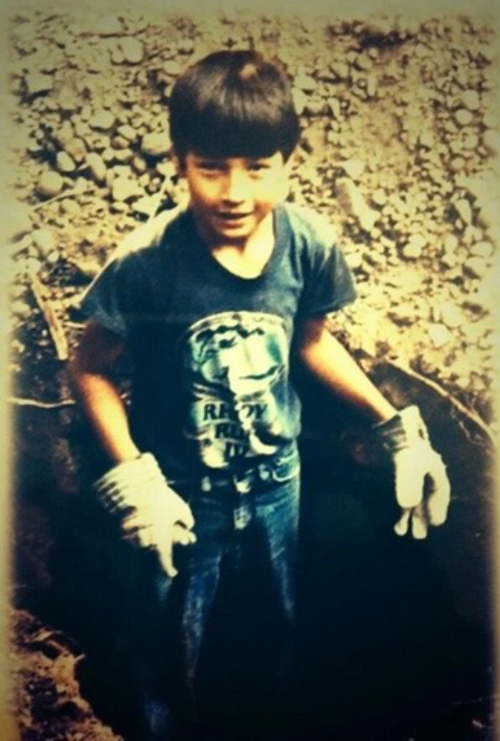
Miles Okazaki, 1982 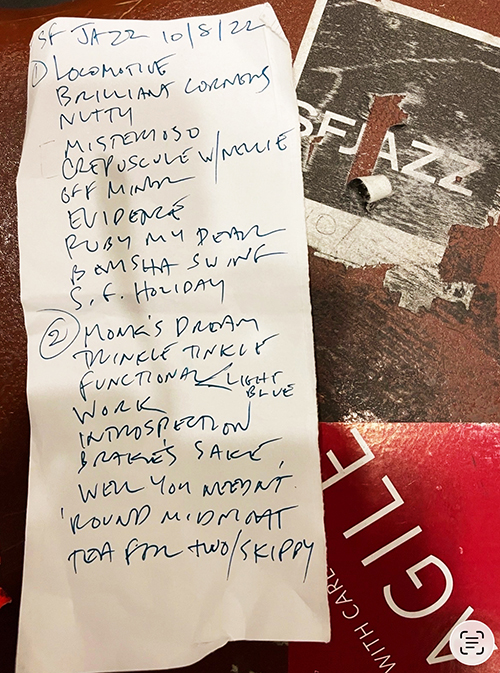
Setlist, SFJAZZ 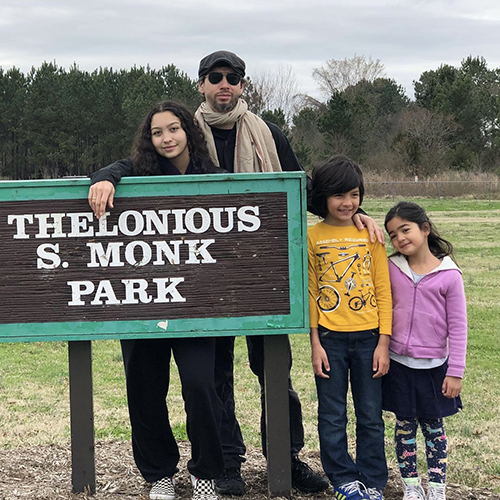
Rocky Mount, NC 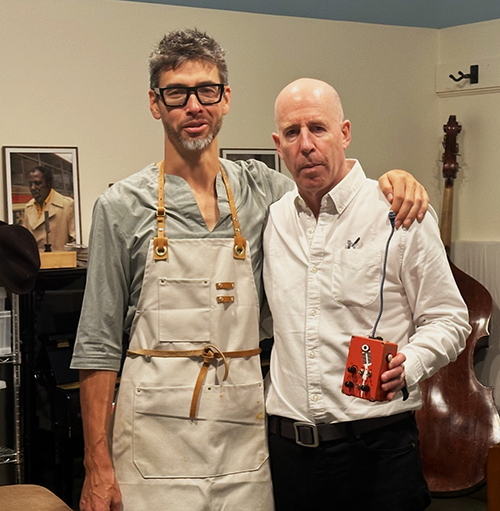
David Breskin 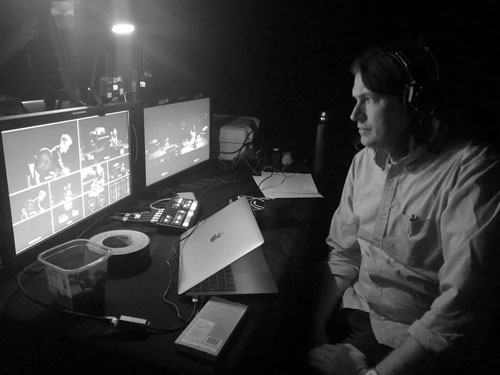
Frank Heath 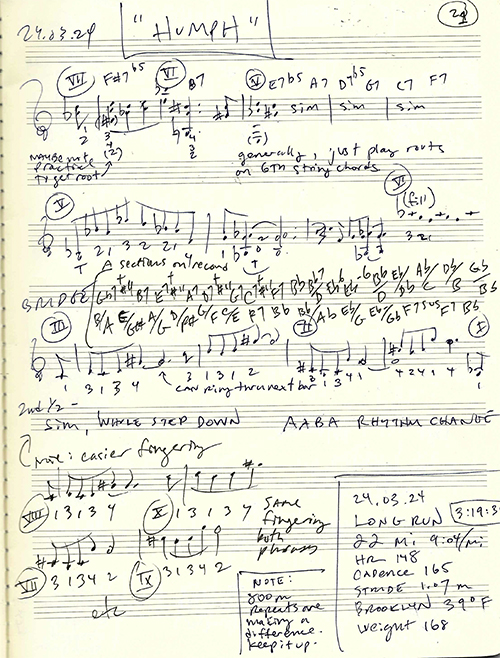
Training Notebook 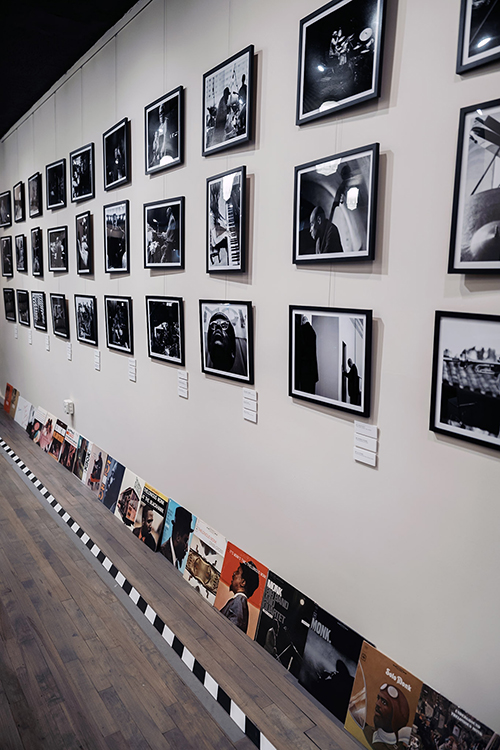
The Jazz Gallery 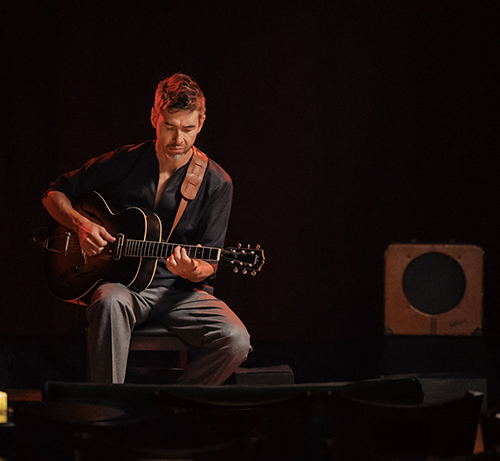
Soundcheck 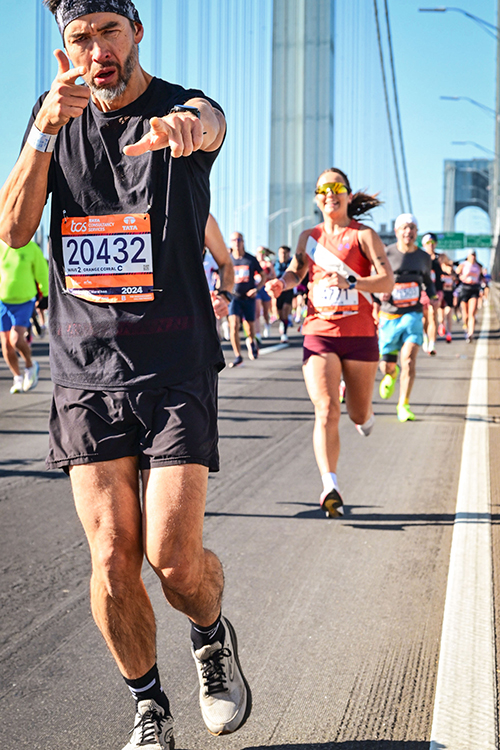
NYC Marathon, 2024 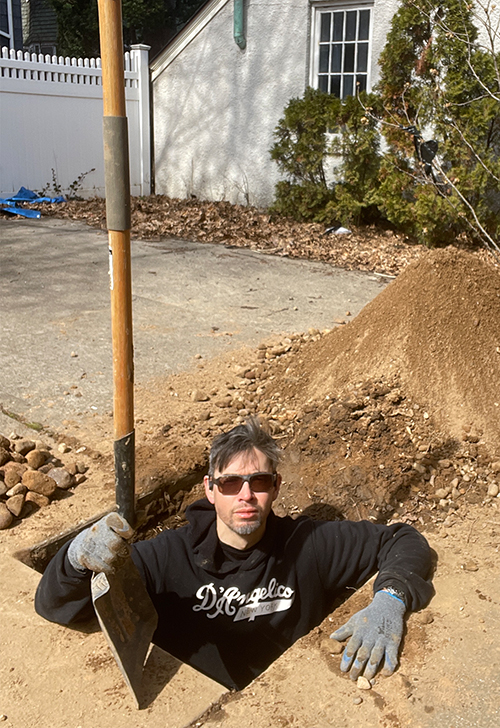
Miles Okazaki, 2022